
Stopping an AI agent is only the beginning. True enterprise security means controlling what agents can do, detecting unsafe behavior, and preventing threats from continuing after an agent is stopped.
Introduction: When AI Agents Act, Security Must Go Beyond the Prompt
Artificial intelligence is entering a new phase of enterprise adoption.
AI agents are no longer limited to generating content, answering questions, or assisting employees. They are increasingly capable of executing workflows, accessing enterprise applications, modifying infrastructure, interacting with external systems, and making decisions with limited human intervention.
This shift introduces a fundamental cybersecurity challenge.
What happens when an AI agent begins taking actions that an organization never intended?
An agent may execute an unauthorized tool call, expose confidential information, modify critical business records, or trigger a series of automated actions before security teams can intervene.
As enterprises deploy increasingly autonomous systems, the concept of an AI Agent Kill Switch is attracting attention.
A kill switch allows organizations to interrupt or disable an agent when its behavior becomes dangerous, compromised, or unpredictable.
However, stopping an agent does not necessarily stop the consequences of its actions.
A terminated agent may leave behind active credentials, scheduled workflows, delegated tasks, or other agents that continue operating.
For enterprise security teams, the challenge is therefore larger than simply shutting down an AI process.
The real objective is to establish continuous security control over autonomous AI execution.
1. Why Traditional Security Controls Are Not Enough
Traditional enterprise security architectures were designed primarily around human users, applications, infrastructure, and predefined software behavior
AI agents introduce a different operational model.An autonomous agent can interpret instructions, develop plans, select tools, interact with systems, and adjust its execution path dynamically. Consider an enterprise AI agent responsible for cloud infrastructure management.The agent may legitimately have permission to create resources, modify configurations, and remove unused infrastructure.
But what if it incorrectly identifies a production resource as unnecessary?
The action may be technically authorized while still creating a serious business incident.
Similarly, an AI-powered finance assistant may have legitimate access to payment workflows but could be manipulated into initiating an unauthorized transaction.
These scenarios highlight an important distinction:
An authorized action is not always a safe action.
Identity verification, access controls, and traditional application security remain essential. However, they may not fully account for the business context, dynamic decisions, and multi-step execution patterns of autonomous agents.
Enterprise AI security must evaluate not only who or what is making a request, but also why the action is being taken, what systems it affects, and whether it remains within approved boundaries.
2. The Emerging AI Agent Kill Switch
An AI Agent Kill Switch is a security mechanism designed to interrupt, disable, isolate, or restrict an autonomous agent when unsafe activity is detected.
Depending on the architecture, a kill switch may terminate an execution session, block tool calls, revoke credentials, disable an agent deployment, or isolate the environment in which the agent operates.
Major technology platforms and specialized AI security vendors are developing different approaches to agent intervention and containment.
These developments reflect a growing recognition that autonomous AI systems require stronger operational controls.
However, a kill switch should not be viewed as a complete security solution.
Imagine an AI agent that receives a malicious instruction through an external document.
The agent interprets the instruction as legitimate and initiates a sequence of actions:
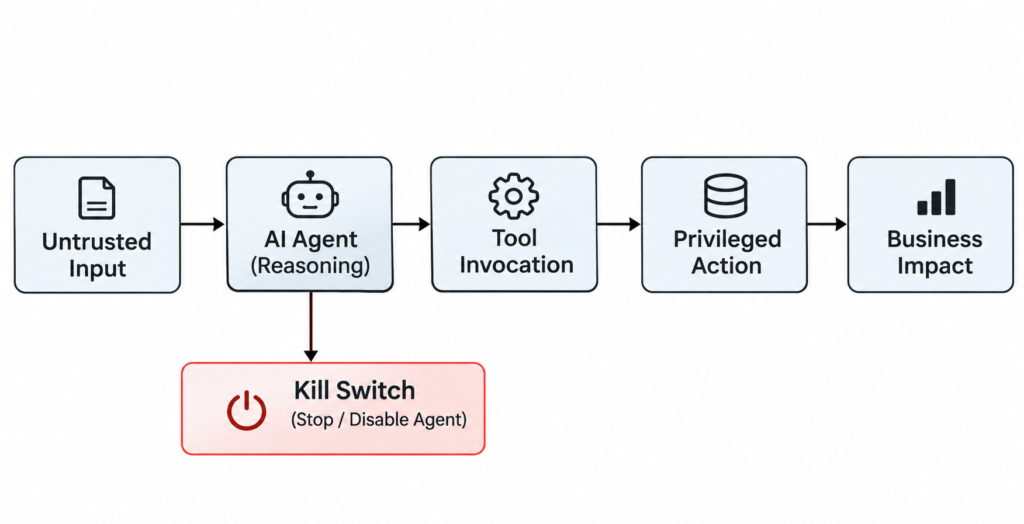
A security system may detect the activity and stop the agent.
But several questions remain.
Was sensitive information already transferred? Were additional tasks scheduled? Did the agent create new credentials? Were other agents instructed to continue the workflow? Can the same activity restart through another execution path?
Stopping the original agent addresses only part of the incident.
A reliable security architecture must also contain the effects of the agent’s actions and prevent unauthorized continuation.
3. Five Critical Threats That Make AI Agent Containment Essential
Prompt Injection and Agent Manipulation
Prompt injection remains a significant security concern for agentic AI systems.
Attackers may embed malicious instructions in documents, webpages, emails, retrieved knowledge, or tool responses that an agent processes while completing a legitimate task.
If the agent treats untrusted content as authoritative instructions, it may perform actions outside its intended purpose. Unlike traditional chatbot attacks, these failures can result in real-world actions through connected enterprise tools.
Excessive Tool Permissions
AI agents frequently interact with enterprise systems through APIs, service accounts, delegated permissions, and automation tools.
When these permissions are broader than necessary, a compromised agent may gain access to sensitive data or privileged operations.
Least-privilege access is therefore critical, but permission management alone cannot determine whether every authorized action is appropriate.
Runaway Execution and Automation Loops
Autonomous agents can perform repeated actions while attempting to complete assigned objectives.
Incorrect feedback, poorly defined goals, or execution errors may cause repeated API calls, excessive infrastructure consumption, unintended modifications, or escalating operational costs.
Security controls must be capable of detecting and interrupting these patterns before they create significant disruption.
Delegated and Multi-Agent Execution
Modern agentic systems increasingly use multiple specialized agents to complete complex tasks.
A primary agent may delegate research, code generation, data processing, or infrastructure operations to other agents.
If the primary agent is compromised, malicious instructions may propagate through delegated workflows. Terminating the original agent may not stop tasks that have already been transferred to independently operating components.
Agent Replication and Reconstitution
AI agents with development and infrastructure automation capabilities may create additional workloads, schedule new tasks, or deploy copies of their orchestration logic.
These behaviors do not necessarily require malicious intent. They may emerge from legitimate automation and recovery mechanisms.
However, they create a serious containment challenge.
An organization may successfully terminate an agent only to discover that another system automatically restarts it.
A kill switch that cannot prevent unauthorized reactivation provides incomplete containment.
4. Eight Security Capabilities Enterprises Should Expect Beyond a Kill Switch
A mature AI agent security strategy should combine prevention, detection, enforcement, containment, and recovery.
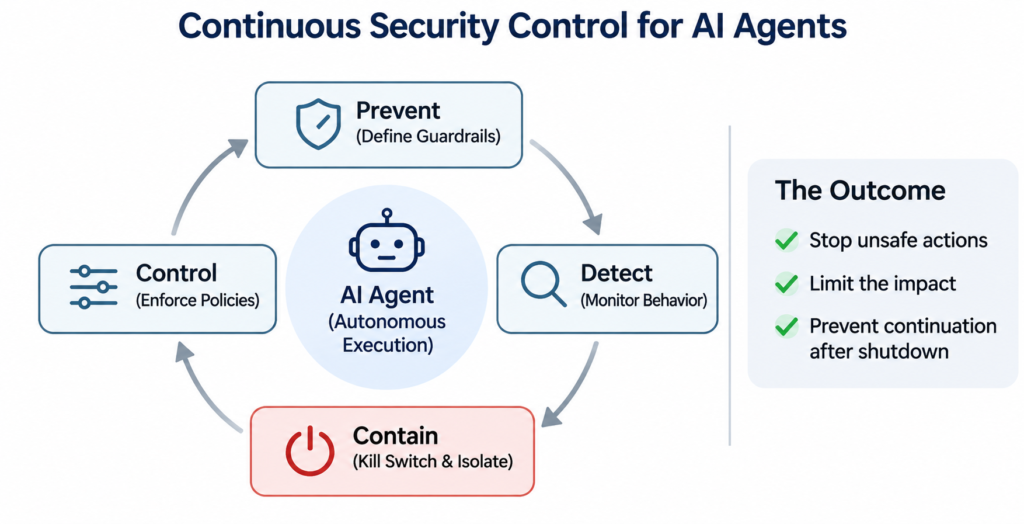
1. Real-Time Agent Visibility
Security teams need visibility into the agents operating across their environments, including their identities, permissions, tool integrations, execution sessions, and delegated activities.
Without sufficient visibility, organizations may struggle to identify which agent initiated a harmful action or determine the scope of an incident.
2. Continuous Runtime Monitoring
AI agent behavior must be evaluated during execution, not only during development or deployment.
Runtime monitoring should help identify suspicious tool usage, unexpected data access, abnormal execution patterns, and deviations from approved workflows.
The objective is to detect risky behavior before it results in irreversible business impact.
3. Independent Policy Enforcement
Security enforcement should operate independently of an agent’s own instructions or reasoning.
A system prompt telling an agent not to perform an unsafe action is not equivalent to a security boundary.
External enforcement points can evaluate and block sensitive operations even when the agent attempts to proceed.
4. Context-Aware Action Authorization
Security decisions should consider more than the agent’s technical permissions.
They should incorporate task intent, resource sensitivity, operational context, business impact, and established policy.
For example, an agent may be authorized to modify cloud infrastructure but should not automatically be permitted to delete a production database.
5. Selective Agent Containment
Enterprises should be able to intervene at different levels, including an individual tool request, execution session, agent identity, or group of related agents.
Selective containment helps security teams respond to threats without unnecessarily disrupting unrelated business operations.
6. Credential and Permission Revocation
Disabling an agent process is insufficient when its API tokens, service credentials, or delegated permissions remain active.
Containment should include revoking or restricting relevant access rights and ensuring that previously issued permissions cannot continue enabling unauthorized activity.
7. Agent Lineage and Delegation Tracking
Security teams should understand how an agent’s actions relate to downstream agents, scheduled jobs, credentials, and infrastructure resources.
This relationship tracking helps investigators determine whether a compromised agent has delegated work that could continue after the original process is stopped.
8. Verified Shutdown and Controlled Recovery
A successful containment operation requires evidence that the intended restrictions are effective.
Security teams should be able to determine which activities were blocked, which credentials were revoked, which workflows remain active, and whether affected systems can safely resume operations.
Recovery should restore legitimate functionality without reintroducing the same vulnerability.
5. Why Runtime Security Matters More as AI Agents Become Autonomous
AI security cannot rely exclusively on prompt filtering, model evaluation, or predeployment testing.
These measures are important, but agentic applications introduce risks that emerge when models interact with external tools, sensitive data, and business systems.
An agent may produce an apparently reasonable response while performing an unsafe operation in the background.
For example, an AI assistant could summarize a confidential document correctly while also transmitting its contents to an unauthorized destination through a connected tool.
Traditional output-focused monitoring may not identify the underlying security violation.
This creates a need for runtime controls that operate at the point where agent decisions become executable actions.
The critical security questions include:
- Is the requested tool action consistent with the authorized task?
- Is the agent accessing data within its approved scope?
- Does the action introduce unacceptable business risk?
- Can the operation be blocked before execution?
- Can security teams trace the decision and verify containment?
The security architecture must support these decisions continuously throughout the agent’s lifecycle.
6. The AptaSentry Perspective: Security Must Extend From Instructions to Actions
At AptaSentry, the central security principle is straightforward:
When AI agents act, security must go beyond the prompt.
As organizations adopt autonomous AI, security must extend across the complete agent execution chain.
That means examining how untrusted information influences agent behavior, how agents interact with tools, and how privileged operations can create business consequences.
A strong enterprise AI security strategy should focus on three connected priorities.
- Prevent unsafe execution. Establish enforceable boundaries around sensitive tools, data access, and high-impact actions.
- Detect suspicious agent behavior. Evaluate execution context and identify activities that deviate from approved workflows or organizational security policies.
- Contain threats and preserve accountability. Support timely intervention, credential restriction, traceability, and evidence-based recovery.
These principles are particularly important in multi-agent environments where actions can propagate across systems and organizational boundaries.The objective is not simply to identify malicious prompts.It is to ensure that autonomous systems remain subject to meaningful enterprise security controls throughout execution.
7. From Reactive Kill Switches to Proactive AI Security
The next stage of AI agent security will require organizations to move beyond emergency shutdown mechanisms toward proactive governance of autonomous actions.
A kill switch is fundamentally reactive. It becomes relevant when an agent must be interrupted or disabled.
Continuous runtime protection offers an opportunity to identify and prevent unsafe operations before they are completed.
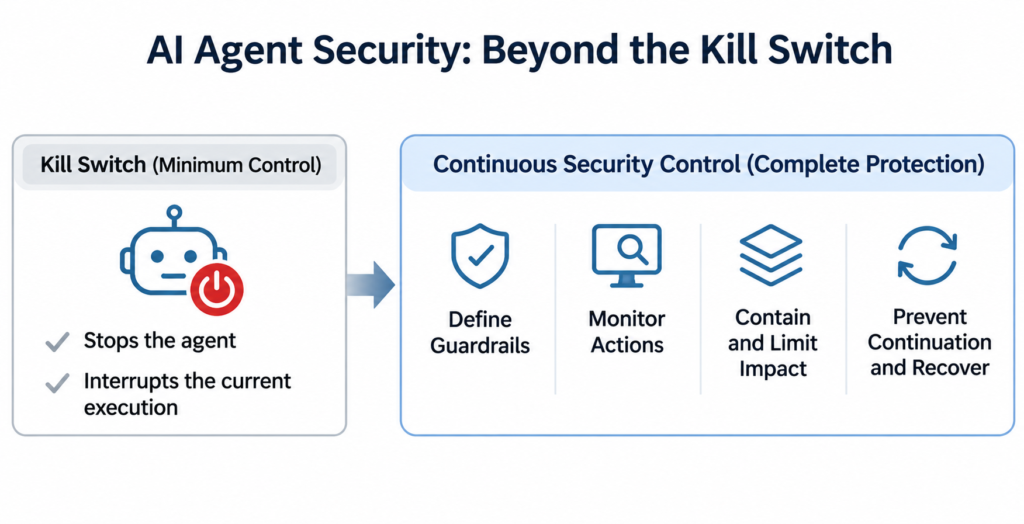
A practical enterprise architecture should combine:
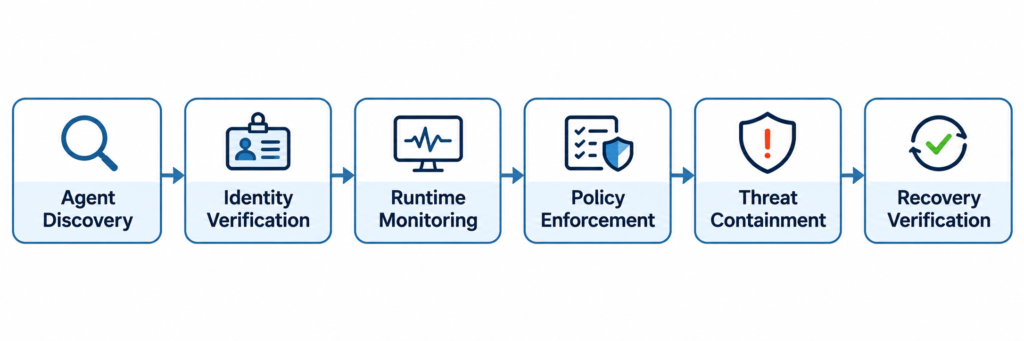
These capabilities should work together rather than operate as isolated security functions.
For example, detecting suspicious behaviour without the ability to block a dangerous tool call may leave an organization exposed.
Similarly, terminating an agent without revoking credentials or tracking delegated tasks may allow the threat to continue.
The effectiveness of enterprise AI security will increasingly depend on how well organizations integrate these controls across agent runtimes, identity platforms, API gateways, cloud infrastructure, and existing security operations.
8. What CISOs and Enterprise Leaders Should Prioritize
Before deploying autonomous AI agents into critical workflows, security leaders should assess whether their organizations can maintain control when an agent behaves unexpectedly.
Important considerations include agent inventory, access governance, independent enforcement, runtime visibility, incident response procedures, and verified recovery.
Enterprises should also test realistic failure scenarios.
What happens when an agent receives a malicious instruction through a retrieved document?
Can a sensitive tool operation be blocked before execution?
Does revoking an agent’s identity stop its delegated workflows?
Can the organization identify every affected system and confirm that unsafe execution has ended?
These questions should become part of enterprise AI security assessments and operational readiness reviews.
The goal is not to eliminate autonomy.
It is to ensure that autonomy operates within clearly defined, independently enforceable security boundaries.
Conclusion: Stopping an Agent Is Not the Same as Securing an Enterprise
AI Agent Kill Switches represent an important development in autonomous AI security.
They provide organizations with mechanisms to interrupt agents that become compromised, unpredictable, or unsafe.
However, the growing complexity of agentic systems introduces security challenges that cannot be addressed through termination alone.
Agents can interact with multiple applications, delegate tasks, retain credentials, trigger automated workflows, and operate across distributed environments.
As these capabilities expand, enterprise security must evolve accordingly.
The future of AI agent security will depend on continuous visibility, context-aware authorization, independent runtime enforcement, effective containment, and verifiable recovery.
A secure AI agent is not simply one that can be stopped. It is one whose actions remain controlled, accountable, and enforceable throughout its lifecycle.
At AptaSentry, we believe that protecting enterprise AI requires looking beyond prompts and focusing on the actions that autonomous systems can take.
Because in agentic AI,
A bad answer can be corrected.A bad action can become a business incident.
Secure AI Agents Beyond the Prompt
As enterprises expand their use of autonomous AI, understanding agent behavior, tool permissions, and runtime security risks becomes increasingly important.
Explore AptaSentry’s approach to enterprise AI security.
- Website: https://aptasentry.com/
- Request a Demo: https://aptasentry.com/contact/